
What You Can Do and How to Protect Yourself
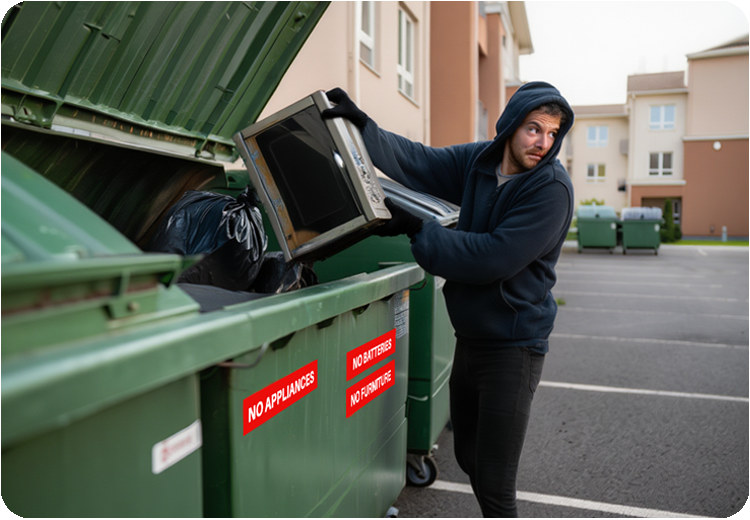
When looking at the real challenge of illegal garbage dumping, you have to look at the problem from multiple angles before acting upon a solution. Of course, the true goal is to catch and fine the people who are doing it, or even better, to prevent it from happening.
Please note that the solutions discussed here depend on the laws and bylaws of your region. We advise you to check with a lawyer if the solution you prefer is legally possible.
To understand all the challenges better, let’s take a look at a real scene:
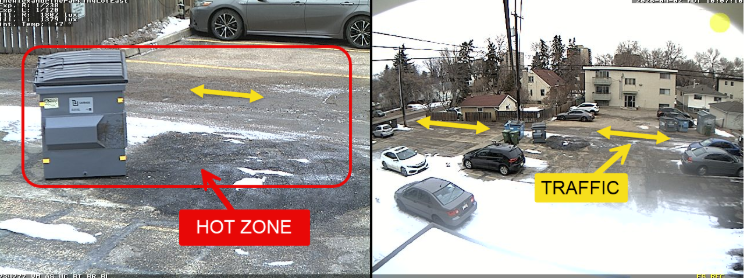
This camera shot shows a garbage can of an apartment building, which has been hit with illegal garbage dumps multiple times. This is a dual-sensor camera which shows an overview on the right side and a zoomed-in view on the left. Now, what is your first impression of this setup? Is it enough to help with the problem? The answer might surprise you, but it depends.
Let’s analyze the situation: vehicles can pass through the HOT ZONE in both directions and for good reasons. It’s not a private area, which means it is totally normal to get traffic by vehicles of any type, as well as on foot.
Tenants of this apartment building will walk up to throw garbage into the bin since it is set up for them. Could a camera be programmed to record such an event? Naturally, yes. The first difficulty starts with identifying whether the person is authorized to do this or not. Any camera or AI would have extreme difficulty with this since we have too little information to judge accordingly.
You might say that it is easy if we take the direction of the person approaching the bin into consideration, but it could still be totally ok when a tenant drives up and parks his or her car, then walks up to the bin to dispose of garbage, and only then walks towards the building. This would be a cause for a false positive alarm.
However, the biggest problem is identifying people illegally dumping garbage, either by driving by and parking right next to the bin or by walking by and throwing something in. Here is where it gets interesting: in the example above, the left sensor of the camera provides an excellent view, which allows a building manager to identify the tenants of the building easily, as long as he has met them before. Also, if a tenant of the building across this one would dump something, the manager could pass the ticket on to this building’s manager and prove it with a video.
Unfortunately, with this setup, it is impossible to record and see license plates of vehicles easily. Therefore, it is not possible to go after people who drive up and dump stuff afterwards. License plate recording and/or recognition highly depends on the angle from which you are able to record the plates. In addition to that, you might be forced to record from both directions if your province or state only requires a plate on the back.
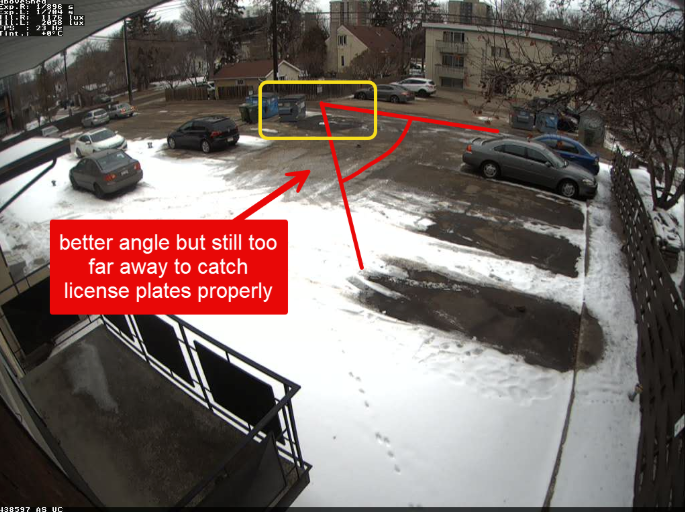
Here’s the same area from a different camera, but while the angle is better, and a zoomed-in camera might be able to get good license plate readings, it’s still a very close call. Just to clarify, the purpose of this camera is to give a general overview of the parking lot and not to record plates.
Now, coming back to the challenge of recording license plates, things might get even worse, since there are provinces – such as Alberta – which have white plates with red letters on them, making it impossible to use infrared illuminators to record plates easily at night, instead white light is required so that the red doesn’t get washed out and merged into the white background.
Luckily, today’s technology helps to counter most, if not all, of those obstacles. So, let’s now focus on the solutions IPTECHVIEW can offer to make this work for you:
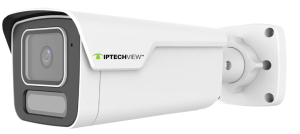
First, we offer a series of ColorHunter cameras, which allow for coloured shots, even at night, helping with the identification of any offenders and their vehicles. Second, we would recommend using an automated LPR camera to record license plates, which can read them and store them in an easy-to-manage database. You can use this database for triggering alerts – especially for repeating offenders – or simply to pass them on to local authorities charged with finding and prosecuting them.
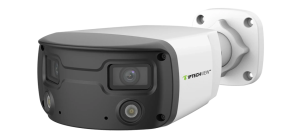
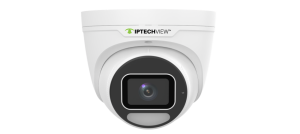
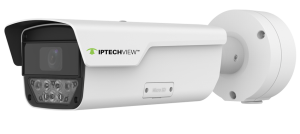
For walk-up offenders, a system can be created where tenants authorize themselves before walking up to the bin so that the system knows that this person is allowed to dump garbage. Any smart access control system or a connected button inside the building would be sufficient to disable alerts for a short period of time.
Even in cases where there’s no Internet connection, IPTECHVIEW can help in 2 ways. First, we offer a selection of 4G/5G cellular routers that connect remote systems to the internet using the cell phone network. Second, if no immediate alerts are required, the system can be installed completely autonomously to record events for post-event analysis and viewing. However, since the system would not be able to send alerts for functional issues, it is highly recommended to connect it to the cloud, since otherwise the owners could never be 100% sure that it is operational and/or has been damaged due to vandalism or natural disasters.
So, the best advice we have is to talk to one of our IPTECHVIEW licensed partners or to use it directly, and we will help you design a solution that works for your individual needs.
Comments are closed